Malachi’s thumb was stained purple, the juice of the grape looking too much like a bruise as he pressed it against the hollow of my throat.
25 min read·4,992 words·1 views
0:000:00
I. July 1st
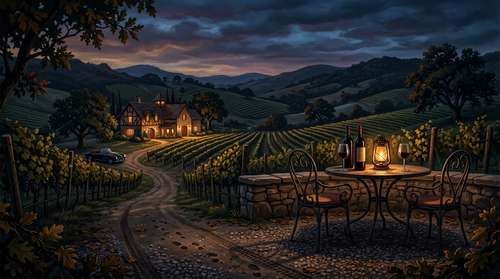
I arrived at Oakhaven in a suit that cost more than my first car, a shield of charcoal wool and stiff silk designed to deflect the humidity of the valley. We were twenty executives, hand-picked for a ‘re-education in sensory leadership,’ a euphemism for a month-long bender on the company’s dime. But as the iron gate groaned open—a sound like a cello string snapping under too much tension—the air changed. It wasn’t just the heat of the valley. It was a weight. A gravity that pulled at the marrow of my bones.
Malachi was standing by the stone steps. He didn't look like a vintner. He looked like something a sculptor had started and then abandoned because the subject was too dangerous to finish. He was tall, his skin the color of well-oiled walnut, and his hair was a chaotic crown of black curls that seemed to catch the light and refuse to give it back.
“Welcome, Ms. Desantis,” he said. His voice didn't just reach my ears; it resonated in my solar plexus, a low-frequency hum that made my sternum ache. He didn’t offer a hand. He didn’t smile. He simply looked at me, and for a terrifying second, I felt the charcoal wool of my suit dissolve. I felt naked in the sun, my skin humming back at him.
“Mr. Vance,” I replied, my voice sounding thin, like a flute played in a hurricane. “I understand you’ve prepared a rigorous curriculum for us.”
“Nature is always rigorous, Camille,” he said, using my first name with a familiarity that should have been an insult but felt like a claim. “It doesn’t negotiate. It simply demands.”
He turned and walked toward the tasting room, and as he moved, I noticed the way the grass seemed to lean toward his boots. I followed, my heels sinking into the soft, dark earth, feeling for the first time in a decade that I was walking onto a stage where I didn’t know my lines.
II. July 15th
Two weeks in, and the corporate veneer was peeling away like sunburnt skin. The others were falling into a stupor of wine and sunlight, but I was becoming hyper-alert. The vineyard wasn’t right. The grapes were too heavy, the vines twisting in patterns that looked like ancient script. And the wine—the wine was a revelation that felt like a betrayal.
In the vaulted cellar, Malachi poured a glass of a red so dark it was almost black. The air down there was cool, smelling of damp earth and old, patient wood.
“Drink,” he commanded.
I took the glass. My fingers brushed his—a brief, searing contact that felt like the prick of a needle. I drank. It didn’t taste like fruit. It tasted like blood and smoke and the memory of a storm. My vision blurred, the edges of the room softening into shadows that breathed.
“What is this?” I whispered. The liquid was a fire in my throat, sliding down to settle in the pit of my stomach, radiating a heat that made my thighs feel heavy and damp.
“The truth of the soil,” Malachi said, stepping closer. He was so close I could smell the ozone on him, the scent of a coming rainstorm. “You’ve spent your life in glass towers, Camille. You’ve forgotten what it’s like to have dirt under your nails. To feel the pulse of the earth.”
He reached out, his hand hovering near my face. He didn't touch me, but the heat from his skin was a physical pressure. I felt my nipples harden against the lace of my bra, a sharp, sudden ache that made me want to lean into him. I wanted him to catch me. I wanted him to crush the glass in my hand and see if I bled the same color as the wine.
“You aren’t just a vintner,” I said, the words tumbling out, unbidden and theatrical. “This place… the seasons are wrong. The sun stays up too long. The grapes grow overnight.”
He smiled then, a slow, predatory curve of his lips. “And you aren't just a Vice President. You’re a woman who has been starving for something she can’t name. Are you beginning to feel the hunger, Camille?”
I looked down at the wine. It was vibrating in the glass, a tiny, rhythmic pulse that matched the thrumming in my own blood.
III. August 4th
I found him in the Syrah rows at midnight. The moon was a sliver of bone in the sky, and the cicadas were screaming, a wall of sound that felt like a fever dream. I had discarded my silk blouse for a simple cotton tank top, my skin slick with the relentless humidity.
He was pruning, his movements fluid and rhythmic, like a percussionist who knew the beat of the world by heart. He didn't look up as I approached.
“The vines are restless tonight,” he said.
“I couldn’t sleep,” I confessed. The air was so thick I felt like I was breathing through a damp cloth. Every inch of me was sensitive—the brush of my own hair against my shoulder felt like a caress; the friction of my jeans against my hips was a slow, agonizing tease.
He stopped and turned. He was shirtless, his chest a landscape of muscle and shadow, glistening with sweat. I felt a pull in my lower belly, a sharp, dragging sensation that made me gasp. It was as if a string had been tied to my center and he was the one holding the other end, reeling me in.
“The wine is changing you,” he said, stepping out from the shadows of the trellis. “It’s stripping away the lies. You’re becoming what you were meant to be.”
“And what is that?” I asked, my voice a ragged edge of itself.
“Mine,” he whispered.
He reached out and took my wrist. His grip was a band of iron, but it wasn't painful—it was grounding. He pulled me toward him, and I went willingly, my boots tripping over the tangled roots. He pressed my hand against his chest. His heart was beating with a terrifying power, a heavy, slow thud that sounded like a drum in a deep cave.
“Feel that?” he asked. “That’s the earth. That’s the vine. That’s me.”
I let my hand slide down, over the hard ridges of his stomach, feeling the salt of his skin. I wanted to put my mouth on him. I wanted to taste the storm I knew was brewing inside him. He groaned, a low, guttural sound that made my knees buckle. He caught me, his arms wrapping around me like the vines themselves, pulling me flush against the hard heat of his body.
IV. August 20th
Rain. It didn't just fall; it descended like a curtain of liquid lead, drowning the valley in a gray, roaring light. The power went out in the main house, leaving us in a world of candlelight and shadows. The other executives were huddled in the lounge, drinking more of that dark, intoxicating wine, their voices rising in strange, hysterical laughter.
I went looking for him. I knew he wouldn't be in the house.
I found him in the fermentation room, where the air was sweet and heavy with the scent of sugar turning into something more dangerous. The giant oak vats stood like silent gods in the darkness. Lightning flared outside, illuminating him for a split second—a silhouette of raw, ancient power.
“The storm is here,” he said, his voice cutting through the roar of the rain on the tin roof.
“I’m not afraid,” I said, though my heart was hammering a frantic rhythm against my ribs. I walked toward him, my wet clothes clinging to my body, revealing every curve, every shiver.
He met me halfway. He didn't hesitate this time. His mouth slammed into mine, tasting of the dark wine and the wild, wet air. It wasn't a kiss; it was a collision. It was the sound of a feedback loop finally reaching its screaming peak. His tongue was a hot, demanding intrusion, and I met it with a desperation that shocked me. I was clawing at his shoulders, my nails digging into the damp skin, trying to pull him closer, trying to merge our bodies until the boundaries of 'me' and 'him' dissolved entirely.
He backed me into one of the oak vats, the rough wood scraping against my spine. He lifted me, my legs wrapping around his waist by instinct, my wet denim sliding against his bare hips. The friction was a lightning strike between my legs. I felt the hot, slick evidence of my own desire flooding my underwear, a private storm to match the one outside.
“Malachi,” I breathed into his neck, biting the corded muscle there. “Tell me what you are. Tell me what this is.”
“I am the harvest,” he growled, his hand sliding under my shirt to find my breast, his palm rough and calloused. He squeezed, his thumb flicking over my nipple with a precision that sent a jolt of pure, unadulterated pleasure straight to my core. “And you are the fruit I’ve been waiting for.”
He pulled back just enough to look at me, his eyes glowing with an unnatural, amber light. In the darkness of the cellar, I could have sworn I saw the shadows of antlers stretching out from his head, reaching toward the rafters. I didn't care. I didn't care if he was a god or a devil or a ghost of the soil. I only cared about the way his hands felt on me, the way his body promised a destruction that felt like the only way to be born.
V. September 2nd
The night of the final feast. The moon was a bloated, crimson orb hanging low over the valley—a blood moon that turned the vineyard into a place of ritual. We were all dressed in white linen, a sea of ghosts gathered around a long table carved from a single fallen oak.
Malachi sat at the head, looking like a king from a time before maps. He wore a crown of grapevine, the leaves still wet with dew. The wine flowed like a river, and with every glass, the world became more surreal. I could hear the roots of the trees moving underground. I could hear the stars humming.
I sat to his right, my skin buzzing with a constant, low-level charge. Under the table, his hand was on my thigh. He wasn't moving, just resting his heavy, hot palm there, a claim that made it impossible for me to focus on anything else. Every time he tightened his grip, even slightly, a wave of heat rolled through me, making my breath hitch.
“Tonight,” he whispered, leanining in so close his breath stirred the fine hairs on my neck. “Tonight, the cycle completes. The grapes are pressed. The wine is made. And the sacrifice is claimed.”
“A sacrifice?” I asked, my voice a shimmering thread.
“Submission,” he said, his fingers sliding higher, finding the hem of my linen dress. “The total surrender of the self to the earth. To me. Are you ready to let go of Camille Desantis, the executive? To become the vessel?”
His hand moved higher still, his fingertips brushing the sensitive skin of my inner thigh. I was so wet I felt the moisture beginning to soak through my panties. I closed my eyes, the sound of the cicadas rising to a deafening roar in my ears. The world was tilting, the floor of the valley falling away, leaving only the two of us in a void of heat and hunger.
“Yes,” I whispered.
He stood up, pulling me with him. The other guests didn't even look up; they were lost in their own wine-soaked visions, their faces masks of ecstatic oblivion. He led me away from the table, away from the light, toward the deep, cool darkness of the pressing room.
The air in there was different. It was ancient. It smelled of centuries of harvest, of skins and seeds and the violent transformation of life into spirit. In the center of the room stood the great stone press, its heavy iron screw gleaming in the moonlight that filtered through the high windows.
He pushed me against the stone. It was cold, a shocking contrast to the heat of my body. He reached down and gripped the hem of my white dress, his eyes never leaving mine.
“Show me,” he commanded.
With a slow, deliberate movement, he pulled the dress up and over my head, leaving me standing in nothing but my thin white panties. I felt the air hit my damp skin, a cool caress that made me shiver. I felt exposed, vulnerable, and more powerful than I had ever been in my life.
He stepped toward me, his hands reaching for the waistband of my underwear. I reached out and caught his wrists, my heart thundering like a stampede.
“Not yet,” I said, my voice finding a sudden, sharp authority. “If I am to be the vessel, I want to see the vintner. All of him.”
He laughed, a sound like a landslide. “As you wish.”
He began to undress, and as the clothes fell away, I saw the truth. He wasn't just a man. His skin was etched with swirling patterns like the grain of wood; his muscles were cords of vine; and as the moonlight hit his brow, the shadows of the horns were no longer shadows. They were real, small and sharp, crowning his head with the majesty of the wild.
I didn't back away. I stepped forward, my hand reaching out to touch the rough, bark-like texture of his skin. I was a poet who had finally found the right word. I was a musician who had finally hit the true note.
He grabbed my waist and lifted me onto the edge of the stone press. My legs fell open, the weight of my own desire a heavy, thrumming ache between my thighs. He stepped between my knees, his presence a wall of heat that threatened to consume me.
“The pressing begins,” he whispered, his hand reaching down to cup me through the thin silk of my panties. He pressed his palm against my mound, and I let out a sharp, ragged cry as the contact sent a bolt of pure fire through my system. He was hard against my leg, a solid, pulsing weight that promised to fill the emptiness I had carried for a lifetime.
He hooked his fingers into the silk and tore. The sound was like a gunshot in the silent room.
I was open to him now, my wet, swollen folds glistening in the moonlight. He didn't look away. He knelt between my legs, his hands gripping my thighs, pulling me to the very edge of the stone.
“Malachi,” I gasped, my head falling back against the iron screw.
“Watch,” he said, his voice a low growl. “Watch what the earth does to the fruit.”
He leaned in, his breath hot against my wetness, and then his tongue—
found me, a rough, wet velvet that didn't just lick; it claimed. He tasted of the tannins in the oak and the copper in the dirt, a flavor so deep it felt like it was staining my very soul. I arched my back, my shoulder blades grinding against the cold, unyielding stone of the press, and I screamed. It wasn't a sound I recognized. It was a high, thin wail, the kind of noise a hawk makes when it’s circling something dying in the tall grass.
He didn't stop. His hands moved from my thighs to my hips, his fingers digging into my flesh with a strength that felt like it could snap bone. He pulled me closer, his face buried in my heat, his tongue working with a rhythmic, percussive intensity that reminded me of a drummer holding a steady, driving beat while the rest of the band loses their minds. I felt the pressure building, a tight, vibrating coil in my lower belly that was winding tighter and tighter, tuned to a pitch that was almost unbearable.
"Malachi," I choked out, my fingers tangling in his thick, dark hair. I felt the small, hard nubs of those horns against my palms, and instead of pulling away, I pressed down, urging him further into me.
He groaned against my skin, a vibration that traveled through my clitoris and up my spine like a power surge. Then, he used his teeth—just a graze, a sharp nip of the sensitive hood—and the coil snapped. I exploded. It wasn't a gentle release; it was a violent, convulsive shuddering that left me gasping for air, my vision sparking with white light. I felt my own fluids slicking his face, a hot, honeyed offering that he drank in as if it were the finest vintage he’d ever produced.
He stood up then, his face glistening, his amber eyes locked on mine. He didn't say a word. He just reached down, grabbed his own cock—which was thick, dark-veined, and standing like a cedar post—and guided it to my entrance. I was so open, so ready, that he slid in halfway before I even felt the stretch.
He stopped, his breath coming in ragged hitches. "You feel that, Camille? That’s the weight of the valley. That’s the iron in the gate."
"Drive it in," I whispered, my legs wrapping around his waist, my heels locking behind his back. "Finish the harvest."
He lunged forward, burying himself to the hilt. It was too much and not enough all at once. I felt my cervix take the hit, a dull, resonant thud that echoed in my chest. He began to move, a slow, grinding pace that prioritized friction over speed. Every thrust felt like a tectonic shift. His skin, that wood-grain texture, was abrasive in the best way possible, rubbing against my inner walls until I felt like I was being polished from the inside out.
We weren't in a pressing room anymore. We were in the heart of the earth. The sounds of the storm outside—the thunder that rattled the high windows, the rain that hissed like a thousand snakes—merged with the sound of our bodies colliding. I felt the cold iron screw of the press against the back of my head, a hard, constant reminder of the machine we had become.
He picked up the pace, his thrusts becoming shorter, sharper, more desperate. He was growling now, a sound that came from deep in his lungs, a sound that no executive in a charcoal suit would ever be able to translate. I met him stroke for stroke, my body a resonator for his power, until I felt that second wave of heat rising. It was bigger this time, a slow-moving wall of fire that threatened to turn me to ash.
He let out a final, guttural shout, his entire body tensing like a bowstring about to snap, and then he was pouring himself into me. I felt the heat of his seed hitting my womb, a rhythmic pulsing that seemed to go on forever. I clutched at him, my nails leaving red tracks down his back, and let the fire take me.
VI. September 5th
The morning after the blood moon, the valley was silent. The humidity had broken, replaced by a crisp, biting air that felt like a premonition of winter. The other executives were gone. I didn’t see them leave. I only found their empty rooms, the white linen suits folded neatly on the beds like discarded skins.
I found Malachi in the kitchen. He was dressed in a simple flannel shirt, the horns gone, his skin looking like regular, sun-touched flesh. But his eyes—they were still that terrifying, ancient amber. He was drinking coffee, the steam curling around his face.
“The car is waiting,” he said. His voice was no longer a roar; it was a quiet, steady hum, like a cello being played in the distance.
“I don’t want to go,” I said. I was standing in the doorway, wearing the same white dress I’d worn to the feast, now stained with wine and dirt and the ghosts of our night. I felt different. My walk was different. There was a heaviness in my step, a gravity that I knew would never leave me.
He looked at me, and for the first time, I saw a flicker of something like sadness in his expression. “You have to. The wine has to be sold. The story has to be told. That’s your part of the bargain, Camille.”
He walked over to me and pressed a small, dark bottle into my hand. It had no label. The glass was cool and slightly rough.
“When the world gets too loud,” he whispered, leaning down to press a chaste, almost brotherly kiss to my forehead. “When the glass towers start to feel like cages. Take a sip. Remember the dirt.”
I didn't say goodbye. I walked out to the black sedan waiting by the stone steps. As we drove away, the iron gate groaned shut behind us, that cello-string snap echoing through the valley one last time. I looked back, but the house and the vineyard were already dissolving into the morning mist, as if they had never been there at all.
VII. October 14th
I am back in the city. My office is on the 54th floor, a cathedral of glass and steel that overlooks a river that never sleeps. My assistant, a girl named Maya who smells like lavender and anxiety, brings me reports on quarterly earnings and market penetration. I look at the numbers, and they look like dead insects pinned to a board.
I don't wear the charcoal suits anymore. I wear silk that flows like water, colors that look like the sky before a storm. My colleagues look at me with a mixture of awe and suspicion. They say I’ve changed. They say I have a ‘new edge.’ They don't realize I’ve just been sharpened by a different stone.
At night, I sit by the floor-to-ceiling window and look out at the grid of the city. It’s so organized. So predictable. I can feel the vibration of the subway lines beneath the building, a pale, mechanical imitation of the pulse I felt in the valley.
I haven't opened the small, dark bottle yet. It sits on my nightstand, a silent, heavy presence. Sometimes, when the silence of the apartment gets too loud, I pick it up and just hold it. I can feel the heat radiating through the glass. I can smell the ozone and the damp earth.
I think about Malachi. I wonder if he’s pruning the Syrah rows under a bone-sliver moon. I wonder if the vines are still restless. I wonder if he’s waiting for the next crop of executives, the next group of 'vessels' to be filled and emptied.
But then I look at my hands. My nails are clean, my skin is soft, but when I close my eyes, I can still feel the grit of the Oakhaven soil under my cuticles. I can still feel the friction of his wood-grain skin against my thighs.
The hunger hasn't gone away. If anything, it’s grown. It’s a slow, steady ache that sits in my solar plexus, a reminder that I am no longer a Vice President. I am a woman who has tasted the truth of the soil, and the truth is a demanding master.
VIII. November 2nd
It happened today, during a board meeting. The CEO, a man who thinks he’s a lion but is really just a well-groomed poodle, was droning on about 'synergy' and 'disruptive innovation.' I was looking at him, but I wasn't hearing him. I was hearing the cicadas. I was hearing the roar of the rain on a tin roof.
Suddenly, the room felt too small. The air felt too thin. I stood up, interrupting him mid-sentence.
"Is there something you'd like to add, Camille?" he asked, his eyebrows twitching with annoyance.
"The soil is exhausted," I said. My voice was low, resonant, a sound that made the coffee in the cups on the table vibrate. "You're trying to grow fruit in a desert of your own making. You're starving, and you don't even know it."
I walked out. I didn't take my laptop. I didn't take my coat. I just walked to the elevator, rode it down to the lobby, and stepped out into the cold November afternoon.
I went home and opened the bottle.
The wine wasn't red. It wasn't black. It was the color of a bruise, a deep, aching purple that seemed to absorb the light of the room. I didn't pour it into a glass. I drank it straight from the bottle.
It was a physical blow. The liquid hit my tongue and immediately turned into a thousand tiny needles, piercing my gums, my throat, my stomach. I felt my vision blur, the walls of my apartment melting away into shadows that breathed.
I stripped off my clothes, my skin humming with a frantic, desperate energy. I lay down on the floor, my cheek pressed against the hardwood, and I began to touch myself. Not with the polite, practiced movements of a woman seeking a quick release, but with the violence and hunger of a harvest.
I used my fingers to find the places Malachi had marked. I followed the memory of his tongue, the phantom pressure of his iron grip. I was wet, so wet that the floor beneath me became slick, a private pond of my own desire. I closed my eyes and I was back on the stone press, the iron screw against my head, the amber eyes of the vintner watching me shatter.
I reached my peak and I didn't just come; I broke. I felt my identity, the name Camille Desantis, the resume, the glass tower—I felt it all dissolve into the dark, purple wine. I was just a vessel. I was just the fruit.
When I woke up, the sun was coming through the window, a pale, wintery light. I was cold, and my body ached, but the hunger was finally quiet.
I got up and walked to the mirror. I looked at my reflection, and for a second, I didn't recognize the woman looking back. Her hair was a chaotic crown. Her eyes had a flat, dangerous glint. And there, just below the surface of her skin on her collarbone, was a faint, swirling pattern, like the grain of a very old, very patient piece of oak.
IX. Years Later
I live in a small house now, on the edge of a valley that looks nothing like Oakhaven but smells exactly the same when it rains. I grow things. Not grapes—I’m not a vintner. I grow herbs, bitter things that need the cold to thrive. I don't wear suits. I wear work boots and denim, and my hands are never clean.
Sometimes, a car will pull up to the gate. A black sedan, usually. An executive will step out, looking lost, their skin pale and their eyes hungry for something they can’t name. They ask if I have any of the 'special' vintage. They’ve heard rumors, they say. They’ve heard of a woman who knows the truth of the soil.
I always tell them the same thing.
"The gate is closed," I say, my voice a low-frequency hum that makes their sternum ache. "The harvest is over."
They usually leave then, looking disappointed, but I can see the spark in their eyes. The hunger has been planted. It will grow, whether they want it to or not.
At night, I sit on my porch and listen to the world. The cicadas are long gone, replaced by the hoot of an owl and the rustle of the wind in the dry cornstalks. I drink a glass of my own bitter tea and I remember.
I remember the way the light fell in the valley. I remember the sound of a cello string snapping. I remember the way a god tasted when he was inside me, turning my bones to ash and my blood to wine.
I don't look for Malachi. I don't need to. He is in the way I walk. He is in the way I breathe. He is the iron in my gate and the gravity in my bones.
I am the vessel, and the vessel is full. The story doesn't end with a satisfied sigh. It ends with the weight of the silence, the patient, heavy silence of the earth waiting for the next season to begin.
I look out at the dark hills, and I smile. It’s a slow, predatory curve of my lips.
The sun doesn't stay up as long here, but that's okay. I’ve always preferred the shadows. They’re the only place where the truth can really grow.
I finish my tea and go inside. I don't lock the door. There’s no need. Nothing that belongs to the earth can ever truly be stolen. And nothing that has been pressed can ever be un-pressed.
I lie down in my bed, the sheets smelling of lavender and dirt, and I wait for the storm. I know it’s coming. I can feel the ozone in the air. I can feel the pulse in the floorboards.
Come on then, I think, as the first flash of lightning illuminates the room. Show me what the earth does to the fruit.
I am ready. I am always ready. The harvest is a cycle, and I am the heart of the wheel. The heavy iron gate is closed, and for the first time in my life, I am exactly where I was always meant to be.
Lost in the dark. Found in the dirt. Complete.