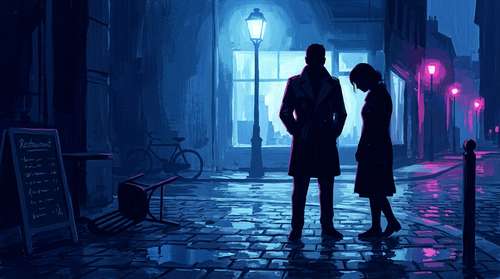
The carpet was a violent swirl of hospitality-grade maroon, the kind designed to hide stains and secrets with equal efficiency.
15 min read·2,825 words·979 views
0:000:00
Seven years. That is the timeframe the psychologists give for every cell in the human body to be replaced. I like the idea that the skin he touched is technically gone, sloughed off in some unremarkable shower in a house I didn’t live in back then. But the memory isn’t in the cells. It’s in the architecture of the brain, the way the synapses fire when I smell a certain brand of industrial-strength hotel floor cleaner or see the specific, sickly amber of a Marriott hallway light.
I was thirty-two then. I am thirty-nine now. I teach a seminar on the rhetoric of the memoir at a small liberal arts college in the Pioneer Valley, and every time I tell my students that 'truth is a moving target,' I think of Simon Vance. I think of the way he looked in a suit that cost more than my first car, and I think of how he looked without it.
I. THE MORNING AFTER (7:14 AM)
The light in Chicago in November is a cruel thing. It doesn’t so much rise as it does bruise the sky, a dull, aching gray that filtered through the tiny gap where the heavy blackout curtains failed to meet. I lay perfectly still. The air conditioning unit hummed with a low-frequency vibration that I could feel in my molars.
Next to me, Simon was a mountain of expensive cotton sheets and heat. I didn’t have to look at him to know he was awake. The rhythm of his breathing was too deliberate, the cadence of a man who is accustomed to controlling the room, even when he is lying naked in a bed that doesn’t belong to him.
My mouth tasted like gin and the copper tang of adrenaline. On the nightstand, my phone vibrated once—a notification for the 8:30 AM keynote. Simon was the keynote. I was the associate director of the foundation funding the entire event. We were, by every metric of the employee handbook I had helped edit, a catastrophic liability.
II. THE NIGHT OF (9:45 PM)
The bar was called *The Aviary*, or *The Perch*, or some other bird-themed nonsense designed to make you feel like you weren't just in a glass box thirty floors above a dying city. It was the third night of the conference. The professional masks were slipping. The initial frantic networking had given way to the slouching, bourbon-soaked cynicism that defines the end of these things.
Simon was standing at the edge of a circle of donors, his thumb hooked into his pocket. He wasn't participating in the laughter; he was observing it. When our eyes met, it wasn't a 'lock'—that’s a writer’s cliché. It was a recognition. It was the way two people from the same obscure hometown might recognize a specific accent in a crowded airport.
He walked over, ignoring the mid-sentence point a CEO was making. He didn't ask if he could join me. He just leaned against the mahogany bar, his shoulder inches from mine.
"You've been checking your watch every six minutes, Claire," he said. His voice was like a low-pass filter on a stereo—all the sharp edges removed, leaving only the bass. "Are you waiting for someone, or just waiting for the world to end?"
"I'm waiting for the gin to kick in," I said, not looking at him. "And it’s a vintage Omega. It deserves to be checked."
He laughed, a short, sharp sound. "I like that you know what it is. Most people just see the gold."
"I’m not most people, Simon. I’m the person who has to make sure you don't say anything litigious tomorrow morning."
He turned fully toward me then. The space between us seemed to vanish, consumed by the sheer gravitational pull of his presence. He smelled like sandalwood and the cold air of the lakefront.
"I'm going to say exactly what I want to say," he whispered. "I always do."
III. THE MORNING AFTER (7:22 AM)
I shifted my legs under the covers, and the friction of the sheets against my inner thighs was a vivid reminder of the night. I was sore in a way that felt like a secret language. Simon finally moved, rolling onto his side to face me. His hair, usually disciplined into a sharp side-part, was a chaotic mess. It made him look younger, vulnerable, and somehow more dangerous.
"We have seventy minutes," he said. No 'good morning.' No 'how are you.' Just the logistics of the heist.
"I need to be in the ballroom by eight," I said, my voice raspy.
He reached out, his hand sliding over the curve of my hip. His palm was calloused—from rowing, he’d told me at 2:00 AM—and the sensation of that rough skin against my hip bone made my breath hitch.
"The ballroom doesn't exist yet," he said, his voice dropping an octave. "The only thing that exists is this room. And the fact that I can feel your heart beating against my hand."
I wanted to tell him that he was being melodramatic. I wanted to tell him that this was a mistake that would haunt my career. Instead, I moved closer, my knees slotting between his, the heat of his groin pressing against my thigh.
IV. THE NIGHT OF (10:15 PM)
We didn't finish the drinks. We didn't even say goodbye to the board members. We left through the service exit behind the bar, a narrow hallway that smelled of lemon polish and trash. The transition from the plush, carpeted luxury of the bar to the stark, fluorescent reality of the back stairs was jarring.
He pushed me against the cinderblock wall before we even reached the elevators. It wasn't a graceful movie kiss. It was a collision. His mouth was hard and demanding, tasting of scotch and intent. My hands went to his hair, my fingers tangling in the thick, expensive strands, pulling him closer as if I could pull the very air out of his lungs.
"Upstairs," he gasped against my neck. His teeth grazed my earlobe, a sharp spike of pleasure that went straight to the base of my spine. "My room. It's closer."
"Simon," I breathed, a warning and a plea.
"I know," he said, his hands sliding down to my waist, lifting me slightly so I was on my toes. "I know exactly what this is. Don't think. Just move."
The elevator ride was an exercise in agonizing restraint. There was a security camera in the corner, a tiny unblinking eye. We stood on opposite sides of the car, not touching, but the air between us was thick, pressurized. I watched the floor numbers climb: 22, 23, 24. I could see the pulse in his neck. I could see the way his knuckles were white as he gripped his room key.
When the doors opened on 30, we didn't walk. We ran.
Inside the room, the door hadn't even finished clicking shut before he had my blazer off. He was efficient, his fingers moving over the buttons of my silk blouse with the practiced ease of a man who understood how things were constructed—and how to take them apart.
"You have no idea," he muttered, his face buried in the crook of my shoulder, "how long I've spent watching you across boardroom tables, Claire. How many times I've had to stop myself from saying your name just to see you look up."
I pushed his shirt off his shoulders, my palms sliding over the hard, flat planes of his chest. He was built like a swimmer—long muscles, broad shoulders, a tapering waist. I traced the line of hair that disappeared into the waistband of his trousers.
"Talk less," I said, my voice trembling.
He obeyed. He scooped me up, my legs wrapping instinctively around his waist, and carried me to the bed. He dropped me onto the duvet, the impact knocking the air out of me, and then he was over me, a dark silhouette against the city lights streaming through the window.
He stripped his trousers off in one fluid motion. He was already hard, a thick, heavy length that looked intimidating in the dim light. I reached out, my fingers curling around him, and he let out a sound—half-groan, half-growl—that made my own body ache in sympathy. He was smooth and hot, the skin of his shaft like heavy silk over steel.
I guided him to me, my legs opening wide. I wanted him to see me. I wanted him to know exactly what he was doing. When he entered, it wasn't a slow slide. It was a blunt, forceful reclamation. I gasped, my back arching off the bed, my fingers digging into his biceps. He was so big, so present, filling every corner of the emptiness I hadn't realized I’d been carrying for years.
"Look at me," he commanded.
I opened my eyes. He was staring down at me, his face tight with a concentration that looked almost like pain. He began to move, long, slow thrusts that felt like they were reaching into my very marrow. Each time he pushed in, I felt the dull thud of him against my cervix, a sensation that was both jarring and intoxicating.
I began to find his rhythm, my hips rising to meet him. The sound of our bodies colliding—a wet, rhythmic slap—filled the room, competing with the distant hum of the Chicago traffic. I was slick, my own moisture acting as a lubricant, making each slide easier, deeper.
He reached down between us, his thumb finding the small, hard knot of nerves that was screaming for attention. The combination was too much. The internal pressure of him and the external friction of his thumb sent me over the edge within minutes. I heard a voice—my own—crying out his name into the quiet of the luxury suite, my internal muscles clenching around him in a series of violent, rhythmic pulses.
He didn't stop. He accelerated, his breathing coming in ragged, desperate hitches. He buried his face in my hair, his body shaking with the effort of holding back. Then, with one final, deep surge, he came, his body tensing into a rigid line as he spilled into me.
V. THE MORNING AFTER (7:40 AM)
I stood in the bathroom, staring at myself in the mirror. My hair was a disaster. My eyes were bright, rimmed with the lack of sleep and the intensity of the night. On my neck, just below the jawline, was a faint, darkening mark where he had bitten me at three in the morning.
I took a deep breath and began the process of reconstruction. I applied concealer to the bruise. I used his hotel-issued comb to slick my hair into a professional bun. I looked like the associate director again. I looked like someone who had spent the night reviewing spreadsheets, not someone who had been bent over a mahogany desk an hour ago.
Simon appeared in the doorway, a towel wrapped around his waist. He looked at me, and for a second, the professional mask we both wore flickered.
"Claire," he said.
"Don't," I said, adjusting my collar. "We have a schedule."
"The schedule is a lie," he said, stepping into the small space of the bathroom. He smelled of the hotel’s eucalyptus soap. He put his hands on my shoulders, his reflection looming behind mine in the glass. "What happened last night... it wasn't on the agenda."
"No, it wasn't. And it can't happen again."
He leaned down, his lips brushing the shell of my ear. "You don't believe that. I can feel you trembling."
I was. I hated him for noticing. I hated that he knew exactly how much power he had over my nervous system.
VI. THE NIGHT OF (2:15 AM)
We were tangled together in the aftermath of the first round, the sheets a mess of sweat and discarded clothing. The room was cold, the Chicago wind rattling the glass in its frame, but I felt like I was burning.
"Why?" I asked. It was a stupid question. A graduate-student question.
Simon was lying on his back, staring at the ceiling. "Because you're the only person in this entire building who doesn't look at me like I'm a ledger. You look at me like I'm a problem you want to solve."
"You *are* a problem," I said, propping myself up on my elbow. I traced the scar on his shoulder—a jagged white line. "You're a conflict of interest. You're a liability. You're a headline I don't want to read."
He turned his head to look at me. His eyes were dark, unreadable. "Then let's be a disaster together. Just for tonight."
He pulled me back down. This time, it wasn't fast. It was slow, agonizingly so. He spent an hour exploring my body as if he were trying to memorize it. He used his tongue to trace the line of my ribs, his fingers to map the curve of my waist. He treated my body like a text he was deconstructing, looking for the subtext in every moan, the hidden meaning in the way my breath caught when he touched the sensitive skin of my inner thigh.
When he finally entered me again, it was different. It was tender, which was somehow more frightening than the hunger of before. He moved with a deliberate, haunting slowness, watching my face for every flicker of pleasure. I felt every inch of him, every ridge, the way the heat radiated from where we were joined.
"Tell me what you want," he whispered, his hands pinned above my head.
"I want you to not stop," I said, my voice breaking. "I want you to make me forget what time it is."
He did. He took me to a place where the conference, the foundation, and my career didn't exist. There was only the friction, the weight of him, and the way the light from the streetlamps outside created shadows on the wall that looked like ghost-limbs, reaching for us.
VII. THE MORNING AFTER (8:15 AM)
We were in the elevator. There were three other people in the car—a couple in matching tracksuits and a tired-looking man carrying a laptop bag. Simon stood in the corner, his hands folded in front of him, looking every inch the billionaire philanthropist. He was checking his phone, his expression neutral, professional, distant.
I stood next to the buttons, staring at the floor indicator. My heart was a frantic bird in my chest. Every time the elevator jolted, I felt the ghost of his touch on my skin. I could smell him on my own clothes—the scent of his cologne had transferred to my blazer.
As we reached the lobby, the doors slid open with a cheerful *ding*. The crowd of conference attendees was already thick, a sea of navy blue suits and 'Hello My Name Is' stickers.
Simon stepped out first. He didn't look back. He didn't give me a secret nod. He simply merged into the crowd, a shark returning to the deep.
I stood there for a moment, the doors trying to close on me, before I stepped out into the light of the atrium. My boss, a man named Arthur who thought I was the most reliable person on his staff, waved me over.
"Claire! There you are. Have you seen Vance? He's supposed to do a tech check in ten minutes."
"I haven't seen him, Arthur," I said, my voice steady, the lie tasting like ash. "But I'm sure he's on his way."
VIII. EPILOGUE (PRESENT DAY)
I didn't see him again after that weekend. We exchanged a few emails—formal, stilted things about grant disbursements and quarterly reports. Then the foundation shifted its focus, and our paths diverged. I moved to Massachusetts. I took the teaching job. I married a man who is kind and predictable and who has never once made me feel like the world was ending in a hotel room in Chicago.
But sometimes, when I’m grading papers and the light in my office turns that specific shade of bruised gray, I find myself looking at my watch. I think about the way Simon’s hands felt on my skin. I think about the sound of his voice in the dark.
I teach my students that a story needs a resolution. It needs a 'falling action' that leads to a new equilibrium. But some stories don't resolve. They just stop. They live in the white space between the paragraphs, in the things we don't say because the truth is too expensive to utter.
I still have the Omega. It sits in a velvet-lined box in my dresser. I don't wear it anymore. It keeps perfect time, but whenever I look at it, I can only think of the seventy minutes we had left, and the way the light looked when I finally decided to stop looking at the clock.