"I Thought You Said You Knew How to Handle a Blade"
The flour on her neck looked like a dusting of California ash, the kind that settles after a wildfire has taken the ridge.
28 min read·5,523 words
0:000:00
1.
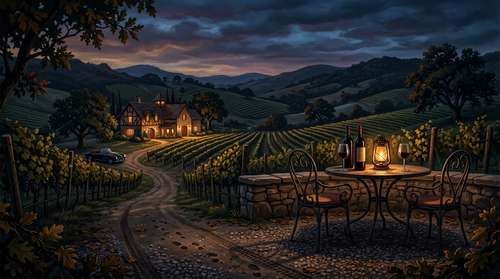
The light in San Gimignano doesn’t just fall; it settles. It has a weight to it, like a heavy wool blanket pulled over the shoulders of the hills. In Oakland, the light is thin and grey, filtered through a permanent ceiling of marine layer that tastes like salt and disappointment. But here, in this villa where the walls are three feet thick and the air smells like rosemary and centuries of suppressed desire, the sun is a physical presence. It feels like a witness.
I’m forty-one, and I’ve spent the better part of two decades looking for the lead—the one detail that breaks a story wide open. You learn to look for the leaks. The way a city councilman sweats when you ask about a zoning permit, or the specific tremor in a witness’s hand. You stop seeing people and start seeing evidence.
I didn’t expect to find evidence here. I came to Tuscany to stop seeing. I came to the Villa Serezza because the brochure promised ‘sensory grounding’ for people with my specific... affliction. They call it the Sfumato. In the trade, we call it the Bleed. It’s a glitch in the hardware. Some people see ghosts; I see the residual heat of people’s intentions. I see the orange glow on a chair where someone sat in anger. I see the blue frost on a door handle touched by someone in grief. After twenty years on the crime beat, the world looked like a psychedelic nightmare of old traumas.
But here, they teach you to cook. They say if you focus on the alchemy of salt, fat, and heat, you can drown out the Bleed. You can make the world just be a room again.
2.
She arrived on the third day. Her name was Maren. She wasn’t the type of woman who usually signs up for a five-thousand-dollar culinary retreat in the Italian countryside. She didn’t have the manicured desperation of the tech-wives from Menlo Park or the brittle, expensive exhaustion of the New York lawyers.
She looked like she had just walked out of a newsroom in 1994. Her hair was a dark, unruly tumble that she kept hacking back with a cheap plastic clip. She wore a faded black t-shirt with a bleach stain on the hem and jeans that had seen better decades.
When she walked into the communal kitchen, I didn’t see the usual hazy aura of personality. I saw a vacuum. She was a localized cold front. Where everyone else in the room was radiating the soft, buttery yellow of 'vacation relaxation,' Maren was a sharp, focused violet. It was the color of someone who had spent a long time being the smartest person in a room full of idiots.
Our instructor, a man named Gianluca who looked like he’d been carved out of a very handsome piece of olive wood, gestured for her to take the station next to mine.
"Elias," Gianluca said, his voice a gravelly baritone. "Maren. Today we work with the pasta. No machines. Just the hands. The heat of the palms is the secret. You must feel the gluten wake up."
Maren looked at the pile of '00' flour on her marble slab, then at me. Her eyes were the color of the Pacific on a cloudy day—not blue, not grey, but something deep and restless.
"You're the one who stares," she said. No preamble. No polite 'hello.'
"I'm a journalist," I said, falling back on the old defense. "I observe. It's a habit."
"Former journalist," she corrected, her fingers dipping into the flour. "You have that look. Like you're waiting for someone to lie to you so you can feel something."
I felt the Sfumato flare up. The violet around her deepened, pulsing with a sudden, sharp heat. It wasn't anger. It was a challenge. I felt it in my teeth.
3.
We spent four hours kneading. It’s a violent, repetitive process. You use the heels of your hands to push the dough away, then fold it back, rotate, and repeat. It’s rhythmic. It’s supposed to be meditative.
But the kitchen was eighty-five degrees, and the humidity was climbing. Sweat started to bead on Maren’s upper lip. I watched a single drop travel down the column of her throat, disappearing into the collar of her black shirt.
"You're overworking it," I said. I shouldn't have said it. I should have kept my eyes on my own dough.
She stopped, her hands buried in the yellow mass of flour and egg. "Excuse me?"
"You're pushing too hard. You’re trying to kill it. It’s pasta, Maren, not a hostile witness. If you keep grinding it like that, it’ll be tough as a tire. You have to be... persuasive."
She wiped her forehead with the back of her wrist, leaving a streak of white flour across her brow. "Persuasive?"
"Yeah. Firm, but with a light touch. Like you're convincing it to do what you want, rather than forcing it."
She stepped closer. The kitchen was crowded, a dozen people at long marble counters, but the space between us seemed to contract. I could smell her. She didn't smell like the expensive perfumes of the other guests. She smelled like cedarwood and sharp citrus and the specific, metallic scent of ozone before a storm.
"Show me," she said.
I hesitated. In the Sfumato, the air between us was turning a dangerous, shimmering gold. That was a new color. I didn't have a label for gold.
I reached out. My hands were covered in flour, dry and dusty. I placed them over hers, which were still resting on the dough. Her skin was hot—unnaturally so. It felt like she was running a fever, or like she was holding back a massive amount of kinetic energy.
"Lean into it," I whispered. I moved her hands with mine. I felt the resistance of the dough, and beneath that, the subtle give of her muscles. We moved in unison. Push. Fold. Rotate.
Our bodies were inches apart. I could feel the heat radiating off her chest. Every time we pushed forward, our hips brushed—just a ghost of a contact, a graze of denim against denim.
"Better?" I asked. My voice sounded like it had been dragged over a gravel road.
She didn't look at the dough. She looked at me. The violet in her aura was being eaten alive by that gold. "It's definitely... something."
4.
That night, the villa was quiet. Most of the guests had retired to their rooms, exhausted by the sun and the Chianti. I couldn't sleep. The Bleed was too loud. The walls of my room were screaming with the echoes of every traveler who had stayed there—brief flickers of loneliness, the dull thrum of marital boredom, the occasional spark of a secret affair.
I went down to the cellar. It was the only place where the stone was thick enough to mute the noise.
I found Maren there, sitting on a wooden crate next to a rack of 2012 Brunello. She was drinking straight from a bottle, her legs kicked out in front of her.
"The journalist returns," she said, toasted the air with the bottle. "Looking for a scoop?"
"Looking for a way to turn the volume down," I said. I sat on the crate opposite her. The cellar was dim, lit only by a few low-wattage bulbs that cast long, dramatic shadows. It looked like a set from a noir film—all high contrast and hidden corners.
"You see it too, don't you?" she asked. She didn't sound drunk. She sounded incredibly, painfully sober. "The mess people leave behind. The stains on the air."
I froze. I’d never told anyone about the Sfumato. It’s the kind of thing that gets you a psych evaluation or a very lonely life. "I don't know what you're talking about."
She laughed, a short, dry sound. She leaned forward, the gold light around her intensified until it was almost blinding to my heightened senses. "Don't lie to me, Elias. I've been watching you all day. You flinch when you walk through a doorway where someone had a fight. You look at the furniture like it’s haunted. You’re a burner. Just like me."
"A burner?"
"That's what they called us back home. In the hills. We take in the world's static and we have to find a way to burn it off. Some people use drugs. Some use art. I used to be a litigation specialist. I’d walk into a courtroom and just... absorb all the predatory intent. It made me very good at my job. It also made me want to claw my own skin off."
She took a long pull of the wine.
"So why the cooking class?" I asked.
"Gianluca. He’s one of us. But he’s figured out the trick. You don't just burn it off. You transform it. You put it into the food. You give it back to the world as something useful."
She stood up and walked toward me. The cellar was cold, but as she approached, the temperature seemed to rise ten degrees. She stopped when her knees were touching mine.
"I'm tired of being useful, Elias," she whispered.
She reached out and traced the line of my jaw with her thumb. Her skin was like a live wire. Where she touched me, the Sfumato vanished, replaced by a sensation so intense it felt like a physical weight. It wasn't just desire; it was the relief of finally being seen by someone who understood the architecture of my particular hell.
I grabbed her wrist. Her pulse was racing, a frantic staccato against my palm. "Maren."
"Don't tell me you aren't hungry," she said. "I can see the hunger on you. It's bright red, right over your heart."
I pulled her toward me. Our mouths met with a kind of desperate, uncoordinated hunger. She tasted of dark cherries and the metallic tang of the wine and something else—something wild and ancient. She didn't kiss like a stranger; she kissed like a debt that was long overdue.
5.
We didn't go back to the rooms. There was a prep kitchen attached to the cellar, a room filled with heavy oak tables and the hanging carcasses of cured meats. It smelled of salt and cold fat.
I pushed her back against the table. The wood groaned under her weight. I was hyper-aware of everything: the rough texture of her denim, the way her breath hitched in the back of her throat, the sound of a distant cricket outside the stone walls.
I pulled her shirt over her head in one clumsy motion. She wasn't wearing a bra. Her breasts were full and pale in the dim light, the nipples already dark and tight. She looked like a marble statue brought to life by sheer, vibrating will.
"Elias," she groaned, her hands fumbling with my belt. "Now. I can't... I have too much in me. I need you to take it."
I stripped out of my clothes, my movements frantic. Every touch was an explosion. When my bare skin finally met hers, it felt like completing a circuit. The gold light in my vision flared so bright I had to close my eyes.
I lifted her onto the table, her legs wrapping around my waist instantly. She was wet, a slick, hot welcome that I felt through the base of my spine. I entered her in one long, driving motion, and the world finally went silent.
For the first time in twenty years, there was no Bleed. There was no past, no future, no residual heat from dead conversations. There was only the friction of her body against mine, the way her internal muscles clamped around me, and the sound of her nails scraping across the old oak table.
I buried my face in the crook of her neck, breathing in the scent of her. I felt her heart thumping against my chest, a heavy, rhythmic counterpoint to the movement of our hips.
"Yes," she hissed into my ear, her teeth grazing my lobe. "Just like that. Give me everything. Burn it all down."
I moved faster, my hands gripping her hips, bruising the skin. She was vocal, a series of low, gutteral moans that vibrated through my own bones. She threw her head back, her throat a long, elegant line in the shadows. I watched the muscles in her stomach contract with every thrust, the sheer physicality of her grounding me more than any meditation ever could.
We were a mess of sweat and friction. I felt the pressure building, a coil of energy at the base of my skull that felt like it was about to snap. I shifted my grip, sliding my hand between our bodies to find the small, hard knot of her clitoris.
She let out a sharp, jagged cry as I began to work my thumb against her. She was incredibly sensitive, her body jolting with every pass.
"Don't stop," she pleaded, her voice breaking. "Elias, please. I'm almost... I'm almost there."
6.
We didn't finish.
Not then.
A door slammed somewhere high above us in the villa. The sound echoed down the stone staircase like a gunshot.
We froze, our bodies still locked together, hearts hammering in the sudden silence. The gold light in my vision flickered and dimmed, the cold grey of the cellar air rushing back in to fill the spaces between us.
Footsteps. Heavy, deliberate. Gianluca’s boots.
"Elias? Maren?" his voice called out from the top of the stairs. "Is someone down there? The alarm for the humidity sensor in the cellar is going off. The wine must be kept at fifty-five degrees. The heat in that room... it is rising too fast."
I looked at Maren. Her eyes were wide, her pupils blown so large they were almost entirely black. She was trembling, but not from fear. It was the vibration of a bell that had been struck and was still ringing.
I was still deep inside her, the heat of our connection a physical ache that refused to dissipate. I could feel her pulsing around me, a silent, desperate demand for the release we were being denied.
"We have to move," I whispered, my lips brushing her forehead.
She didn't move. She just stared at me, and in the Sfumato, I saw the violet return, but it was shot through with jagged streaks of something new. Something that looked like hunger, but deeper.
"He knows," she whispered. "He knows what we're doing. He can feel the burn."
The footsteps started down the stairs, slow and rhythmic. Each step sounded like a deadline approaching.
I slowly withdrew from her, the sensation of sliding out of her heat feeling like a physical wound. She let out a small, broken sound—half-whimper, half-growl. We scrambled for our clothes in the dark, the fabric of my shirt feeling like sandpaper against my sensitized skin.
We were dressed and standing ten feet apart by the time Gianluca reached the bottom of the stairs, his flashlight beam cutting through the gloom.
He stopped, the light sweeping over the oak table, the empty wine bottle, and finally, our flushed, sweating faces. He didn't look surprised. He looked disappointed, like a teacher catching two students cheating on a test they were supposed to fail anyway.
"The Sfumato is not a toy, my friends," he said softly. The light of his torch caught the gold shimmer still clinging to the air around us. To him, it must have looked like a forest fire. "You are trying to use the fire to put out the fire. It only makes the hunger grow."
He looked at me, then at Maren.
"Go to your rooms," he commanded. "Tomorrow, we work with the knives. If you cannot control the heat, you will bleed for real."
I didn't look at Maren as I walked past her toward the stairs. I couldn't. I felt like if our eyes met, the villa would simply spontaneously combust. But as I passed, her hand brushed mine—a quick, searing contact.
"I'm not going to his class tomorrow," she whispered, so low I barely heard it. "Meet me at the olive grove. Three a.m."
I didn't answer. I kept walking. But my hand, where she had touched it, felt like it was on fire.
7.
My room was a disaster of high-frequency noise. The Sfumato wasn’t a glow anymore; it was a screeching feedback loop. Every floorboard I stepped on groaned with the residual weight of a hundred years of tired travelers. The heavy oak wardrobe in the corner was vibrating with a dull, bruised indigo—the color of a secret kept too long. I lay on the bed, but the linen felt like it was woven from copper wire.
I’ve lived in Oakland long enough to know the sound of a city trying to hold its breath. It’s the low hum of the Port, the distant rattle of the BART train cutting through the night like a serrated blade. You learn to tune it out or you go crazy. But here, the silence was just a vacuum waiting to be filled by the static in my own head.
I checked my watch. 2:14 a.m.
In the newsroom, this was the hour of the final sweep. You’d check the wires one last time, looking for the typo that would make the paper look like a joke, or the late-breaking tragedy that would force a front-page re-layout. It’s the hour when the coffee tastes like battery acid and your eyes feel like someone’s been rubbing them with fine-grit sandpaper. It’s the hour of the Burn.
I got up and pulled on my boots. I didn’t need a flashlight. To my eyes, the hallway was mapped out in the lingering heat signatures of the other guests. I could see where Mrs. Gable from Chicago had paced the hall at midnight, a frantic, jittery yellow trail of insomnia. I could see the cold, clinical blue where the cleaning staff had wiped down the banister.
I moved through the villa like a ghost through a crime scene. I wasn’t Elias the tourist. I was the guy who could find the one blood spatter the forensics team missed because I could see the anger that put it there.
The air outside was a shock. It was late October in Tuscany, and the temperature had plummeted. The mist was rolling off the hills, thick and white, looking for all the world like the marine layer rolling in over the Richmond-San Rafael Bridge. I smelled woodsmoke and damp earth and the sharp, medicinal tang of the olive trees.
I headed for the grove, my feet crunching on the gravel path. The Sfumato started to shift. The jagged spikes of violet and red were being smoothed out by the sheer, indifferent cold of the earth.
8.
The olive grove was an ancient grid of twisted, silver-grey trunks. In the dark, they looked like a crowd of old men frozen in various states of agony or prayer. They’d been here for five hundred years. They didn’t care about my visions. They didn’t care about the static in my brain. They just existed, pulling salt and water from the dirt.
I found her near the center of the grove, where the trees were the thickest. She was standing under a massive, gnarled specimen that looked like it had been struck by lightning in the Renaissance.
She wasn’t wearing the black t-shirt anymore. She had on a thick, oversized wool sweater that made her look small, and a pair of leggings. She was holding something in her right hand.
The gold light was back. It wasn't a glow anymore; it was a corona. It surrounded her like a heat haze off an asphalt road in August. It was so bright it made the silver leaves of the olive trees look like they were forged from brass.
"You're late," she said. Her voice didn't carry. It dropped straight to the ground, heavy and laden with intent.
"The villa is loud," I said, stopping ten feet away. "I had to navigate the wreckage."
She held up her hand. The object she was holding caught a stray sliver of moonlight. It was a chef’s knife—a ten-inch bolster-heavy blade from the kitchen. It was the kind of tool that could take the head off a tuna or slice a tomato so thin you could read a newspaper through it.
"Gianluca said we'd be working with these tomorrow," she said, her fingers tracing the flat of the blade. "He said the edge is where the heat meets the metal. He said if you don't respect the edge, the edge respects nothing."
"Maren, put the knife down."
She laughed, and the gold light flared, a sudden burst of solar-flare intensity. "I'm not going to hurt you, Elias. I’m not even going to hurt myself. I’m just looking for the point. The exact moment when the static stops and the physical begins. I’ve spent my whole life in the static. I want the edge."
She stepped toward me. She wasn't walking; she was stalking, her movements fluid and predatory. When she got close enough, I could feel the heat again. It was like standing next to a kiln. It wasn't the heat of a fever; it was the heat of a machine running at a hundred and ten percent capacity.
"Handle the blade, Elias," she whispered. She held the knife out to me, handle-first.
I took it. The steel was freezing, a brutal contrast to the warmth of her palm that had been gripping it. I felt the weight of it—the balance, the potential. In my world, a knife was evidence. It was a "sharp force trauma" description in a coroner's report. It was the thing that ended the story.
But in her eyes, I saw a different kind of ending.
9.
I didn't put the knife down. I held it at my side, the tip pointing toward the dark soil.
"Is this what you want?" I asked. "To feel something sharper than the noise?"
"I want to disappear," she said. Her hands went to the hem of the wool sweater. She pulled it over her head and tossed it into the dirt. Underneath, she was bare. Her skin was a pale, luminous map in the darkness, but to my eyes, she was a pulsing, rhythmic landscape of oranges and deep, bruised purples. I could see the heat of her lungs as she breathed. I could see the frantic, rhythmic throb of her carotid artery.
"Touch me," she commanded. "Not with the metal. With the hand that knows how to write the truth."
I dropped the knife. It thudded into the soft earth, forgotten.
I reached out and placed my palm against her sternum. Her skin was electric. It felt like the moment a lead-heavy silence is broken by a confession. I could feel her heart hammering against my hand, a wild, trapped animal trying to break through the cage of her ribs.
"Elias," she gasped. She leaned into me, her forehead resting against my chin. "The noise. Make it stop. Please."
I didn't say a word. I didn't have the vocabulary for this. I grabbed her waist, my thumbs digging into the soft flesh just above her hips. I pulled her flush against me, the rough denim of my jeans a harsh friction against her bare thighs.
She let out a sound that wasn't a moan—it was a sob of pure, unadulterated relief.
The Sfumato began to bleed together. The gold and the violet and the red swirled into a single, blinding white light at the center of my vision. It was the "whiteout" of a blizzard, the moment when the camera sensor is overwhelmed and the image just dissolves into pure energy.
I pushed her back against the ancient olive tree. The bark was rough, a thousand tiny knives against her shoulder blades, but she didn't flinch. She welcomed it. She needed the world to be hard, to be physical, to be real.
I knelt in the dirt between her legs. The smell of the earth was overwhelming—damp, ancient, and indifferent. I reached up and hooked my fingers into the waistband of her leggings, pulling them down with a single, violent motion. She stepped out of them, her breath coming in short, jagged hitches.
She was beautiful in a way that had nothing to do with aesthetics and everything to do with intensity. She looked like a live wire that had been stripped of its insulation.
10.
I didn't hesitate. I didn't perform. I moved with the directness of a man who has finally found the lead he's been chasing for twenty years.
I buried my face in the crook of her thighs. She tasted like the air before a thunderstorm—metallic, sharp, and full of ozone. She was already slick, a heavy, viscous heat that coated my tongue. I used my hands to pull her open, my fingers slick with her, feeling the delicate, vibrating architecture of her labia.
She screamed. It wasn't a loud sound, but it was a sound that carried the weight of everything she had been carrying. It was the sound of a burner finally catching fire.
She gripped my hair, her nails digging into my scalp, pulling me harder against her. I worked my tongue against the small, swollen knot of her clitoris, my movements rhythmic and relentless. I wanted to drown out the static with the sound of her pleasure. I wanted to replace the Sfumato with the tactile reality of her body.
"More," she hissed, her legs shaking. "Elias, more."
I stood up, my own body screaming with a need that felt like a physical pressure behind my eyes. I stripped off my jeans, my boots, my shirt, throwing them into the shadows. The cold air hit my skin like a slap, but I barely felt it. I was burning from the inside out.
I lifted her up, her legs wrapping around my waist, her arms locking around my neck. I felt the wet, heavy heat of her pressed against my stomach. I guided myself to her, the head of my penis catching on the slick entrance of her.
I entered her in one slow, agonizingly deep thrust.
She let out a long, low whistle of breath, her eyes rolling back in her head. I felt her internal muscles clench around me—a tight, rhythmic pulsing that felt like it was trying to draw the very soul out of me.
"There," she whispered into my ear, her voice a ragged thread. "Right there. Stay right there."
I didn't stay. I moved. I found the rhythm that had been established earlier in the kitchen—the push, the fold, the rotate. But there was no dough now. There was only the friction of skin on skin, the sound of her back scraping against the olive bark, the rhythmic thud of our bodies meeting.
The Sfumato was gone. The colors were gone. For the first time since I was a cub reporter in a city that didn't know my name, the world was just a room. A grove. A body.
I focused on the details. The way her skin felt like silk pulled tight over a drum. The specific, salty taste of the sweat on her neck. The way her breath caught every time I hit the deepest part of her. I drove into her with a desperation that was bordering on violence, my hands gripping her ass, pulling her harder against me with every stroke.
She was vocal now, a series of short, sharp barks of pleasure that echoed through the trees. She was a riot of motion, her hips meeting mine with an intensity that threatened to break us both.
"Don't stop," she groaned, her teeth biting into my shoulder. "Elias, don't you dare stop."
I felt the pressure building. It wasn't the gold light. It was something darker, heavier. It was the physical accumulation of every story I'd ever told, every lie I'd ever heard, every crime scene I'd ever mapped. It was all distilling down into this one, singular point of contact.
I shifted my weight, pinning her more firmly against the tree, my thrusts becoming shorter, faster, more frantic. I felt the slickness of her juices coating my thighs, the smell of us rising up in the cold night air like steam.
She started to come. I felt it in the way her body went rigid, the way her internal muscles began to spasm in a frantic, uncoordinated dance. She threw her head back, her throat working as she let out a sound that was pure, unadulterated release.
"Yes!" she cried out. "Yes, now! Burn it, Elias! Burn it all!"
I didn't have a choice. The wall broke.
I came with a force that felt like it was going to shatter my bones. It wasn't a release; it was an eviction. Everything I had been holding—the Sfumato, the noise, the ghosts of Oakland, the weight of the stories—it all poured out of me and into her. I felt the heat of it, a literal, physical warmth that flooded her, a bridge built of salt and fluid and desperation.
We stayed like that for a long time, locked together against the tree, our breathing the only sound in the ancient grove.
11.
The light didn’t come back.
Not the gold, not the violet, not the bruised indigo of the wardrobe.
When I finally pulled away from her, the world was just... grey. It was the honest, quiet grey of a pre-dawn morning. I could see the trees, and they were just trees. I could see the mist, and it was just water vapor. I could see Maren, and she was just a woman standing in the dirt, her skin pale and shivering in the cold.
She looked at me, and her eyes were different. They weren't the restless Pacific anymore. They were clear. They were empty.
"It's quiet," she said, her voice small.
"Yeah," I said. I reached down and picked up her sweater, handing it to her. "It is."
We dressed in silence. The urgency was gone, replaced by a heavy, comfortable exhaustion. I felt like I had just finished a double-shift on a lead story that actually mattered. I felt like I could sleep for a thousand years.
I found the knife in the dirt. I picked it up, wiping the damp soil from the blade with the hem of my shirt. The steel was just steel. It wasn't a metaphor. It wasn't an edge. It was just a tool for cutting things.
"What now?" she asked.
"Now we go back," I said. "We wash our hands. We go to Gianluca’s class. We learn how to handle the blade."
She nodded. She reached out and took my hand. Her skin was cool now. The fever had broken.
12.
We didn't stay until the end of the week.
We left the next afternoon, after the morning session with the knives. Gianluca didn't say a word when we told him we were checking out. He just looked at us—at the way we stood close together, at the way the jagged edges of our personalities seemed to have been sanded down—and he nodded once.
"The secret to the blade," he told us as we stood by the taxi, "is not the sharpness. It is the control. You do not cut the food. You allow the food to be divided."
We drove out of San Gimignano as the sun was beginning to settle over the hills. I looked out the window, waiting for the Sfumato to flare up. I waited for the orange glow of the old stone walls, for the blue frost of the shadows.
But there was nothing. Just the light. Just the long, golden shadows of a Tuesday in Tuscany.
In Oakland, the light is thin and grey. It tastes like salt and disappointment. I wondered if, when we got back, the noise would return. I wondered if the Bleed was something you cured, or just something you managed.
Maren was sitting next to me in the back of the car. She was looking at her hands, her fingers tracing the small, red marks my nails had left on her wrists.
"Elias?" she asked, not looking up.
"Yeah?"
"Do you think we're still burners?"
I thought about the olive grove. I thought about the way the white light had felt, the way the world had simply dissolved into the physical reality of her body.
"I think the fire is still there," I said, reaching over and taking her hand. "I just think we finally found a way to use it."
She leaned her head on my shoulder. Outside, the hills of Tuscany rolled by, ancient and indifferent, holding their secrets under three feet of stone. For the first time in my life, I didn't care what they were. I didn't need the lead. I had the story right here. It was quiet, it was heavy, and for now, it was enough.